
It’s almost the end of winter not that that really means anything from what I have to talk about in this newsletter but it does give me my first sentence. My next sentence, what has been happening since the last newsletter, well, lots of things. Some people under this coaching framework ran some races, some won races and some didn’t whilst unfortunately some athletes have been stricken by injury and have had to abort their upcoming marathons. If that’s not you and you’re healthy and happy take this as a reminder to be grateful for that. Injuries can strike whenever and whomever and even though we like to think we can control all the variables to make sure we don’t get injured, it doesn’t necessarily work like that. Even the best runners in the world get injured and they are supposed to be the best at not getting injured so what does that say! A great example of that happening is Jakob Ingebrigtsen has been injured ALL year and came back to win his first race back at the European Athletics Championships a couple of weeks ago. So, if you are ever injured, do not despair, you might just be a few months away from winning the European champs! Moving on, time to get into the meat of this newsletter.

Topics:
- The 3+1 Pillars of Performance
- Aborting a Session
- Fuelling
3+1 Pillars of Performance:
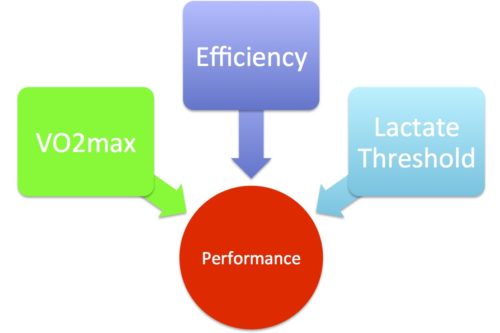
This first topic is all about the three main pillars, and a new fourth pillar that’s been added in modern times with some conjecture, of endurance performance. Running training is designed at improving these three (plus one) areas of performance so understanding what they are and how to improve them (and where your individual strengths and weaknesses are) makes sense right? Yes, you’re damn right!
First one. Maximal Oxygen Uptake. VO2 Max. The metric that defines how much oxygen you can take in and USE during exercise. This is the number that teenage athletes get tested for at various ‘Institutes of Sport’. Unfortunately for many people reading this, the reason why they base talent ID on VO2 Max at these institutes of sport is that it is largely based on your genetics and the best time to improve your VO2 max is when you are young. If you’re over the age of 20 you can still make gains with your VO2 max but it’s hard to grow it past a certain size.
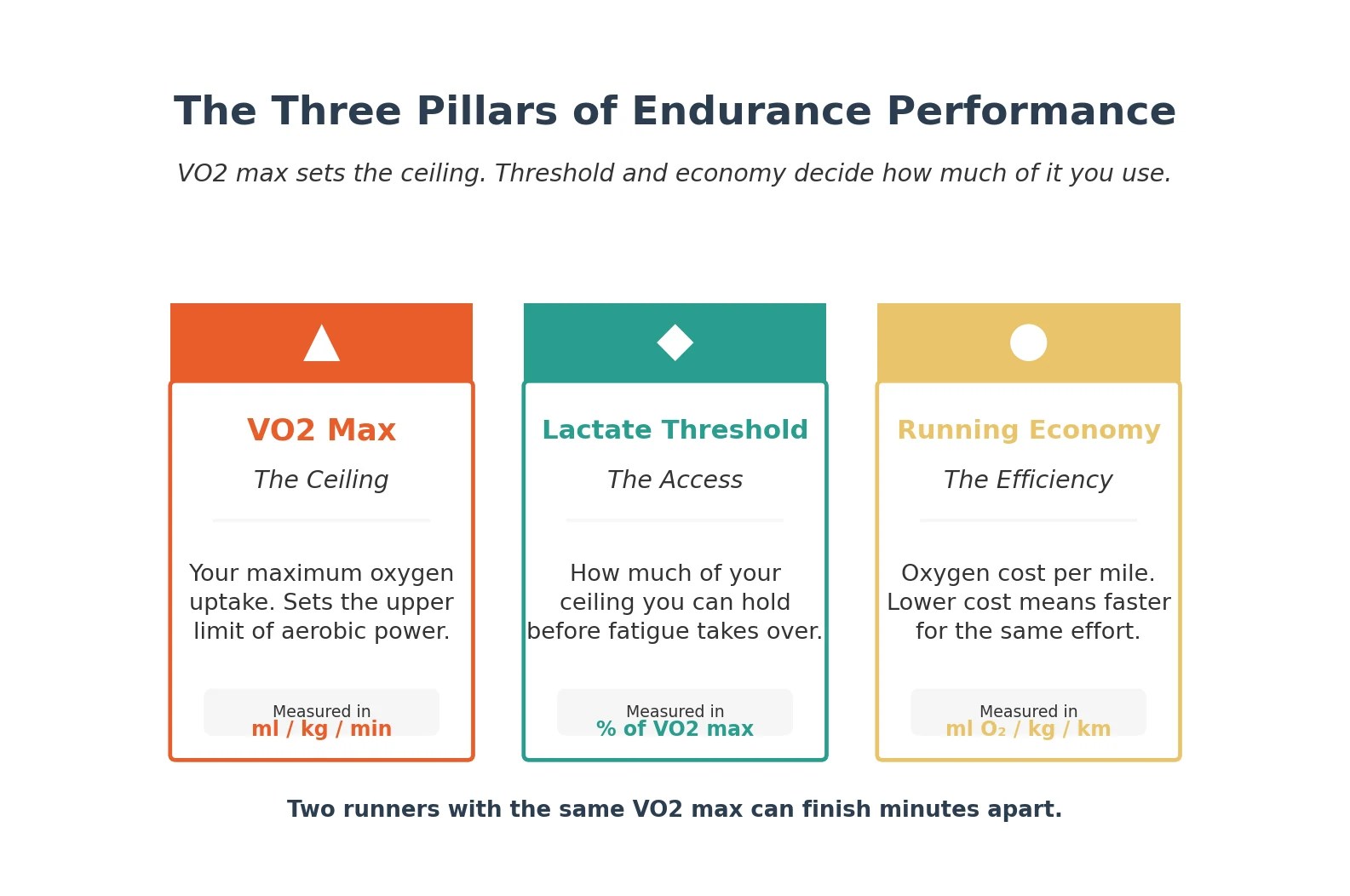
Forgetting that, because it’s demoralising to think you can’t improve something, maybe you already have a great VO2 Max or maybe you have plenty of room left in your attic space and can improve your VO2 ceiling a bit to what your actual ceiling is. It’s easy to understand why we would want to improve this ceiling too. The more oxygen you can take in and USE the more oxygenated your blood is and you can stay aerobically producing energy as opposed to anaerobically producing energy (which has a bigger waste by-product and therefore increases fatigue at a much quicker rate than aerobically doing so).
So what type of training improves VO2 max? Mainly it’s the stuff that targets your physiology when you’re taking in oxygen at the maximum rate. So think, short, hard, fast intervals where you are breathing hard and it’s really painful. You’re literally at your VO2 max and are pushing it up ever so slightly. The other way to improve is to change the denominator in how VO2 max is expressed which is your body weight. So in a very touchy subject with some caution, you can improve your VO2 max by getting lighter which naturally occurs when you do more running than you did when you were just on the couch pretending to be a potato as you might expect. Another fancy way to play with the 1-3% of how to improve your VO2 max is by sitting in a sauna. This part works by changing your blood composition so that your blood can hold more oxygen. Thus you can use more.
Now, all that is important to understand but really, VO2 max doesn’t define most people’s results. It can help to improve it but it’s not something to fixate on for most people as it’s not a huge barrier of improvement in 10km races to marathon or trails stuff which is what most people I coach are focused on.
Second one. Lactate threshold. Now, I talked about this a lot in Newsletter #4 so I’m not going to repeat that. Instead, the message to get across now is that runners who have a high LT1 and LT2 as a percentage of their VO2 max will do better than those who have relatively low LT’s. Hopefully you can already see how yes, it helps to have a high VO2 max so that you can move your LT’s up, but really, it’s how far your LT2 is away from your VO2 max that matters. For some athletes, like Jess Stenson, her LT2 value is really close to her VO2 max. You can see this in her results where all her PB’s are relatively close together in terms of pace as she can access a lot more of her physiology directly under her VO2 max because her LT2 is so high.
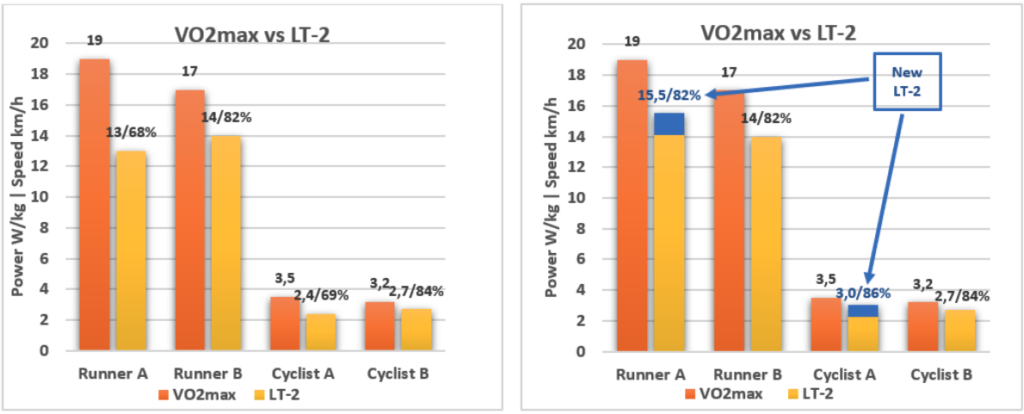
Differently to VO2 max, LT is quite easy to improve. You just do a lot of running under your lactate threshold in different sort of sessions to keep it interesting and over time your body naturally improves all the little processes that go into it. Any running helps and coaches like me can try and get fancy scientifically with creating interesting sessions to give you the most bang for your buck in terms of impact so that your LT goes up sooner rather than later, but really, it’ll go up eventually as long as you stay running. But, in saying that, the trick with training to improve your LT is to make sure you don’t go overboard with it too much and also take a step back every now and then and realise that races aren’t actually governed by who has the better LT. You need to still run the race and learn to actually hold race pace to get a PB!
Third one. Running economy. How efficient is your body at producing energy for the fuel and oxygen you give it. This one is simple and probably the most important one to train and essentially comes from just running lots. You can also improve your efficiency by having good form, choosing the right shoe, doing some plyometrics and gym work to improve the tendon stiffness and elasticity in your muscles. But really, the more you run, the more economical you will become TO A POINT. If you run 500km in a week you’ll be wrecked and very uneconomical. Thats an extreme example but there is a point where you need to take a step back and realise what is helping you and what is hindering you in your chase for mileage to improve your efficiency.
Fourth one. Durability. Some experts think this is a measure of how well your other three pillars are going but I think it deserves it’s own little paragraph. Durability is defined as how long you can keep doing a certain task without fail. So unlike economy, it’s not about how efficient you are (although that helps) but it’s about how long you can stay out there and be efficient and run at just under your LT2 pace, or whatever pace you are holding. Durability is a test of your physiology as much as it is your nervous systems ability to continually stay switched on and not get tired or confused as much as it is a test of your body from a mechanical point of view. How much muscle degradation can you handle before your hamstrings give way?
The easy way to train durability is to follow the running economy playbook. Run lots, do some strength training etc. A little cherry on top of the running economy playbook though is to incorporate different elements of training at the end of a long training session when you are fatigued. Been doing a long run for 2hrs and feel a bit cooked? Wake up your nervous system and do some strides. Don’t want to stress your cardiovascular system but do want to train your muscles to handle long repeated bouts of running? Do some strength training at the end of a run to feel the burn in said muscles. Or run down a really big hill at the end of a run. Anything that basically comes across as a challenge to your mechanical (muscles) or nervous systems and (not your cardiovascular system) at the end of a run is going to improve your durability. I think most recreational runners who train after a long day of work on limited energy sources are always testing their durability and thats why they make great marathoners as opposed to great 5km athletes (your 5km is essentially a test of how long you can hold your VO2 max for too so it makes sense).
Now that was a big topic to get some notes down on but hopefully the picture of how your training week fits into these pillars is clear. All your running is important for improving all of them but your hard sessions are important in improving the VO2 and LT data points while your long run is most beneficial for your economy and durability. So think about your strengths and weaknesses and whats worth focusing on for a bit and then also think about none of it really matters so long as you’re enjoying your training and getting out the door.
Aborting a session.
Now, using that last segue as a sentence into the second topic of this newsletter, getting out the door and doing your training is all well and good if it’s sunny and you’re full of energy. What about if you’re tired or you’re sore or it’s bad weather? Well then there should be room to modify a session or even end it early on those grounds. This is one of the pitfalls of coaching by correspondence. I’m not there with you to ask questions of during the session so you have to in reality coach yourself. BUT, I can guide you with this fancy newsletter and through feedback on FinalSurge on how to best coach yourself in those tricky moments when you’re not sure if you should finish the session.
And here is where I outsource my writing to someone else who put together a great Substack on this very topic. Read it in full here. The short story version is:
- Use the warm up as a diagnostic. Does the niggle get worse? Are you limping? Are you still mopey and unmotivated? If any of that is a yes then stop the run and go rest.
- During the first rep or two, do you hit the paces or recommended effort? Do you take the normal recovery? If it’s a yes, then maybe you just needed a good warm up and were in your head. Continue with the session. If it’s a no and the data is telling you that you are already failing, then just jog instead.
- If after halfway of the session things are getting out of hand you need to ask yourself why is that happening and what is the goal of the workout? If it is to target VO2 max and you are now just running at tempo effort then take a longer recovery and try to shorten the reps so you can get back at VO2 max. If it is to target marathon pace then dial back the pace and aim for marathon effort. I can’t answer for every single situation but through experience as an athlete you will learn how to tweak a session to still hit the aim of the workout.

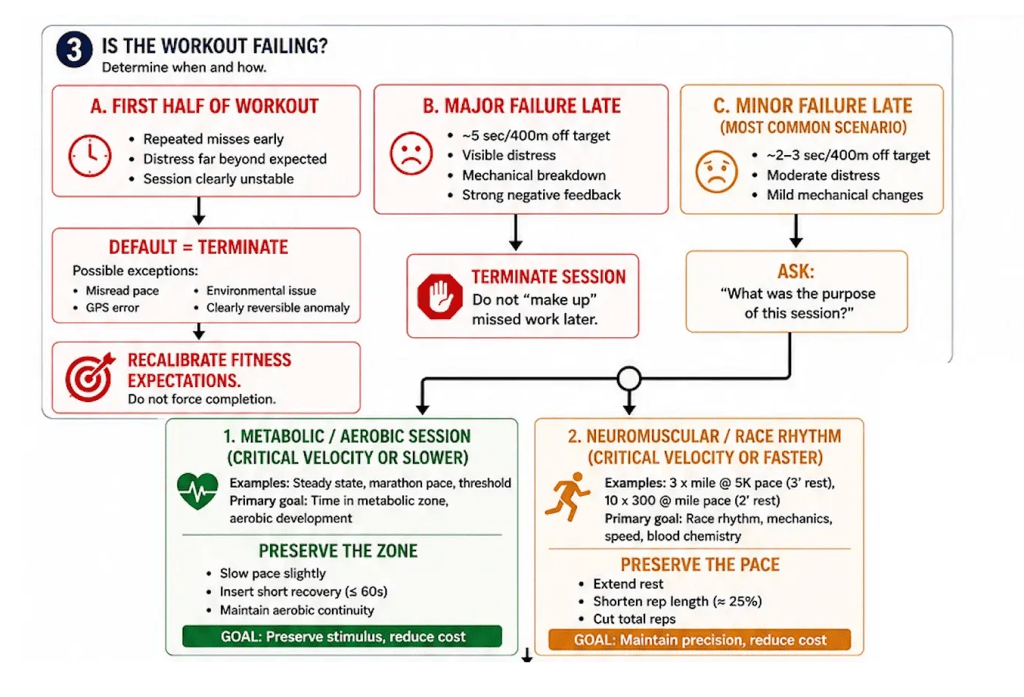
Final word though. Running is fun and any running will likely improve your mental and physical health so long as you’re not injured. So if you find yourself with a session programmed for your run on FinalSurge and you start to hit some of the red flags from above, it’s ok to jog and readjust things in the week.
Fuelling
Consider this the teaser into a full newsletter on it next time. I thought I would include it here first though as it was a suggestion from one of the athletes I coach (so yes, I do take suggestions for these newsletters!) and also because it segues nicely from aborting a session if I choose to focus on fuelling for a session or after a session.
For fuelling before a session. If you’re a morning runner and have a big 1hr + run then the quality of your session will be affected by what you eat for dinner the night before. Assuming you’re not in some major calorie and carb deficit from previous exercise, most people should have a good amount of carbs/energy in their system already so whatever you eat at dinner is just a good top up for that amount. Pasta, rice, pizza, cous cous, easily digestable, things that would you like to eat before a race, they’re all good choices. On the morning of a session or serious run, a light breakfast, toast, crumpets, muffins, honey, jam. Avoid cereal and oatmeal. It can be too heavy. If you’re an afternoon runner then what you eat in the morning and lunch can affect your afternoon run and as I’ve remembered and experienced recently, even eating something too fibrous in the morning can affect your evening session. Key overall message with fuelling before a session is to find things you like and that are easy to prepare and eat well.

For fuelling after a session well things are a little less serious about trying to optimise for your digestion and a bit more serious in terms of your recovery. If you have bothered to get yourself out of bed for a hard session and put in all this effort it is just as important that you follow through with your effort and recover well by eating well after the session. You don’t have to go overboard and buy a protein coffee and a protein banana. No, just eat normal food, even slightly carb heavy especially if you have another big run coming up in the next 24-48hrs. If you have a big long run for example and feel like you fully deplete yourself of glycogen in your muscles (carbs) then it can take a good couple of days of eating to replenish those stocks so if you don’t eat well from Sunday lunch to Monday lunch and only touch the rice cooker on Monday night before your Tuesday session, yikes, you’re probably in danger of running on empty seeing as your fuel tank was never filled back up after Sunday mornings long run! That’s just one example of what to consider when fuelling after a session. Staying topical for this newsletter, if you ever abort a session then that is my personal signal to go and eat a bunch of food without worrying about any nutritional requirements. Using myself as an example, if I have to take a rest day or skip an arvo run, or change a session I know the best remedy to that is to eat lots and become a couch potato until my strength comes back. When I am strong enough and motivated enough to fight a kangaroo (imagine how springy and full of beans you’d have to be to do that!) then that is a sign I am ready for a good session again.
AOB
That’s it for this newsletter. Bit of another long one so sorry about that and thanks for making it to the end. Your prize is the knowledge that for the next newsletter I will be sharing my thoughts on fuelling during a run and at other times in the week from what I have learned as a runner and a coach and a human. Also, last bit of admin, I changed my website the other week to say I am ‘at capacity’ with coaching clients. That’s kind of true and kind of isn’t. It basically means if someone wants coaching they have to really want it and I have to want to coach them and ensure that by taking them on, I can continue to provide the same service to everyone else. It also means, that if for any reason, injury or just taking a break after a race, that anyone who is currently coached by me feels like they need to continue to be coached to reserve their spot then that is not true. I am always supportive of people taking a break and using coaching in blocks towards races/personal goals. So, feel free to pause your coaching if you need to and know that in 99% of scenarios I will still have room for you if you decide to come back to coaching.
That’s all for now, thanks for reading.


Leave a Reply