
Well here we are again, another coaching newsletter. This one has a mixture of topics and by no means should be taken as gospel like anything I’ve ever written on this website or will write on the future. That’s my big disclaimer to absolve myself of any responsibility and also a big signal to you to CRITICALLY COMPREHEND what you are reading. Whether that’s here or somewhere else. If there’s one thing I hope you take away from this newsletter it’s that just because you read something doesn’t make it right, and just because you read something that is right and is good advice doesn’t mean you have to do it or else you will never succeed in your dreams. Just go for a run, have some fun, appreciate the little things in life and move on.
Agenda:
- Fuelling
- Load
- Planning
Anyway with that big disclaimer out the way let’s talk about the first topic. Fuelling. Last newsletter I put down some notes about how to fuel before and after a key session. The main keyword there was ‘key’ session. If you want your performance to be at the best level then it makes sense to put the best fuel in the tank BEFORE the session AND then AFTER the session so you recover and actually gain something from the session. Kind of like putting in Unleaded 98 into your car for a good drive on the highway.

So if that’s the window around the key session covered off, what are you doing for the rest of your week? What fuel do you need in your car to get from the train station to the shops? Unleaded 91 is fine for your little A to B car and driving routes just as any food that ticks off the major food groups is fine for the rest of the week. That’s a pretty basic answer and probably not good enough to cut the mustard. I have two conflicting thoughts on this though, with one being ‘nah, just eat good normal wholesome food and don’t be in too much of a calorie deficit or surplus’ and the other being ‘eat as healthy as you can, the gut drives so much of our brain activity, it’s like a second brain so look after it!’.
Where I come from with these two thoughts is that having watched many high quality outdoor athletes via YouTube survive on the weirdest foods while they do something very very physically demanding, more demanding than the running load I do each week, I seem to think as long as you get the basic food qualities ticked, you’ll find a way to make it work. Think of examples like mountain climbers getting by on various bits of cheese and cured meats as they embark on their 8th day on the mountain or long distance bike riders simply eating copious amounts of pasta, peanut butter sandwiches or cans of coke.

On the other hand is the person who treats their body as a temple and fills the breakfast porridge with fourteen different antioxidant berries and supplements then faces it towards Pluto to ensure maximum aura farming. They have the time to do that and are probably better off for eating grass fed everything and pesticide free that. Maybe they’ve even had their gut biome tested and can sleep confidently knowing that what they put in is good and so what they get out should also be good.
But if it works for the mountain climbers to just survive off freeze dried nutrients, is it worth the extra effort? Would it be better to just eat what most dieticians would recommend as a normal diet and save the extra stress and faff for something else? Like I said at the top, that’s your call to workout if I’m right or wrong here for your situation. All I know from personal experience is I can find ten elite athletes who will say cutting out things like alcohol, ice cream, chocolate cake etc was the difference that made them an elite athlete. I can then find another ten elite athletes who still eat and drink those items and rely on them to turn them into an absolute animal in their chosen sport. So maybe my advice is find what works for you by trying a little bit of each path and analysing your results at the end of it.
Topic two. Load. A while ago I read three articles detailing the different factors athletes have to consider when considering the training ‘load’ in their life. It was on one of my favourite running websites, runningwritings.com, and served as one of the inspirations for putting out my own newsletters. The runningwritings.com information is quite heavy and dense and while I have the time to read it, sit with it, read it again and then take what I need from it for my own training I realise that not everyone has that time or cares enough about it. So here’s a quick summary of what you should at least be aware when managing the training load yourself. (And what I try to manage when setting the ‘load’ in your program).
- Physiological load. This is the element concerned with oxygen, lactates, energy production etc. Did you fail a session because the physiological load on your body was too high? Did you hit your ceiling in your physiology?
- Biomechanical load. The stuff centred around your mechanics. Joints, tendons, muscles, bones. How they move relative to each other, how they are responding to training themselves, are they strong, are they sore, did you fail a session because your legs gave way?
- Psychological load. All about the mind here and how training fits in with everything else in your life. This is the trickiest one to get right and experienced athletes are better at this than inexperienced athletes. Studies show that if you do something stressful before a 5km race you will most often race worse because of it. So keeping the psychological load of sessions and training low (making it seem fun and possible) is an easy way to keep runners engaged with their training whilst managing any ‘burnout’ from continuously doing races/coaching is also an element of concern for mine. Hence why after a major race I prescribe a couple of easy weeks. It’s as much a break for your body as it is for your mind as it is for the coach athlete relationship.
Given these three elements to be aware of in the strategic planning of your training load, it does give another element to analyse your performance as I alluded to vaguely above. Maybe upon reflection you are happy with where your physiology is at but you just aren’t happy with the mechanics of how your body runs. Perhaps instead of focusing on sessions for a few weeks you need to spend time on drills and strides to allow you to operate with some better biomechanics so you can actually reach your physiological ceiling. Or maybe you are happy with your training but it’s your psychological load at the moment that’s got you beat. I was pretty pumped the other day when an athlete informed me they were changing their race plans because they’ve got a busy work period coming up and they’re also not feeling as psyched as they probably wanted to be for a certain race. On one hand someone might say they’re quitting, but on the other it’s a sign that they realise if they overcook things too much in the next month they might not be that stoked with anything they are doing, running or life. For this athlete, instead of focusing on this big upcoming race they can enjoy the level of fitness they have built and put in some great training whilst dealing with the uppercuts that work life might give them.

Another example of the interplay between these three loads is in my own racing where I think I nailed the psychological load and physiological load of my training leading into Sydney Marathon but I could’ve gotten a better result had I been in a better position with my biomechanics. My hamstring had been giving me grief in how efficient I felt in my stride. Whilst I had done a lot of work to come back from a couple of dodgy hip issues at the start of the year my hamstring was still lagging behind a bit along with how my foot/ankle operates. Easy things to overlook when they’re not painful. Granted, I was happy with my outcome at Sydney but it did get me thinking that if I can unlock some better biomechanics between Sydney and Melbourne whilst keeping the physiology and psychology of my life the same then I will be able to compare my two results and see how I go.
Something to think of and if you’re interested in some deeper discussions on these topics with really good detailed information then head to runningwritings.com and work through each of the three articles.
Topic three. Planning. Given all the above about managing load how does that relate in planning your training week? Well ideally there is room to increase the load both in the microcycle and macrocycle from a training perspective. It’s tricky for me to plan appropriately given your own psychological load but the way I can help with that is by being somewhat consistent with my planning for you and being open in my communication about what the theme or goal of the training is at the moment. It works both ways though. I enjoy it when runners communicate upcoming travel, upcoming races or anything else on their mind that may affect their training. Obviously you don’t need to share anything too personal if you’d rather me not know but do know that I only want to hear whats going on in your life so I can help plan training accordingly to get the most out of you! This is where leaving ratings after runs can also help with my planning as I’ve mentioned in the past. If things are going ‘Great’ I can add more training, if things are going ‘Poor’ I can taketh away too.
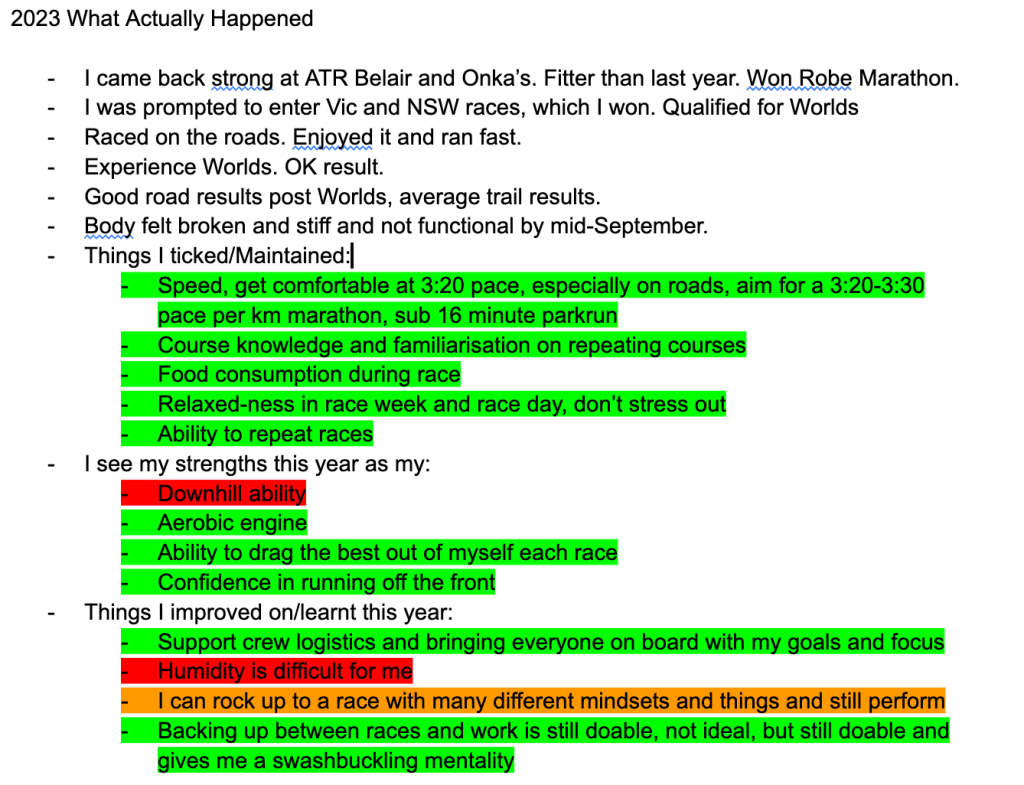
That’s more or less some notes around short term planning but there’s also something worth thinking about with long term planning. Now, I don’t know how long I will work with each athlete when they sign up and no-one is forced to sign a contract staying for the long term. BUT, it is in my best interests, and each runners best interests to think long term about their training so they can be active and healthy in their daily life for as long as possible. I think getting the long term planning is quite hard given the usual flow of training week to week in the lead up to a race. Once that race is done there is usually a recovery period for a week or two and then another race pops up on the calendar. I have tried to set the foundations for some long term planning by asking athletes in the original sign up survey about what they hope to get from their running and also a vague question about strengths and weaknesses. It was the same when I coached at RunAsOne with people being asked to put their long term goals down. I used to enjoy reminding people of these long term goals every few months or so in their monthly program or reminding athletes of how far they’ve come when they tick their goals. Similar has been happening with people who I’ve coached under the fraserdarcy.com umbrella. They sign up, they realise they don’t really know much about their running besides what race they have coming up and then they do some training and realise, hey, I’m a lot closer to my long term goal and vision of what I want out running.
Where am I getting at with this ramble? Well as we approach the end of the year I’ll probably introduce a long term reflection/planning thingo to both look back on 2026 and also look forward to 2027. Doesn’t mean anyone has to stay until they tick off their 2027 goal or whatever, but it just means you’re getting an opportunity, if you want it, to have a long term think about training and running.
AOB
That’s about it for this newsletter. A bit more philosophical than most I hope even if you take nothing from it that you still sat down and read something for 5-10minutes and reflected on your own running throughout. Here’s also the part of the regular newsletter where I talk about advertising to any of friends that need coaching or where last newsletter I said I was at capacity and only had space for people who really wanted coaching and I wanted to coach them. Well, turns out I’ve filled that space with a few people now who have indicated they wanted to be on a waitlist but sounded like good people so I said ‘nae bother’ to the waitlist and will add them to the roster at their chosen start date. What means is now I really am at capacity and now do have a waitlist (all be it with zero people on it but it’s still a waitlist by definition of existing). The same message rings true as always though, if anyone abandons ship I will always throw out the life buoy to let them come back aboard so if you want to take a break from coaching, yes there is room for you to come back still.
Now, summing things up really, the next newsletter will be covering my thoughts on trails, strength and conditioning and cross training. I look forward to the trails aspect of this especially. Once I cover all the little topics I want to in these newsletters I will transition them into something else to do with running/coaching content but that’s still a while away. Anyway, hope you enjoy reading, let me know if you have any questions, otherwise thanks for reading!


Leave a Reply