
Welcome to the second Coaching Newsletter. If this is your first, perhaps take a step to skim read through the first newsletter. The TL;DR version is that to help me help you I explained a few features in FinalSurge and there was a brief discussion on how to differentiate between running for time v distance in an easy run.
In this newsletter I will be covering some of the more fun concepts in training. The agenda is:
- A breakdown of the different ‘run’ categories in FinalSurge and how I use them
- What I look for when I look at your Heart Rate
- Total Km’s for the week
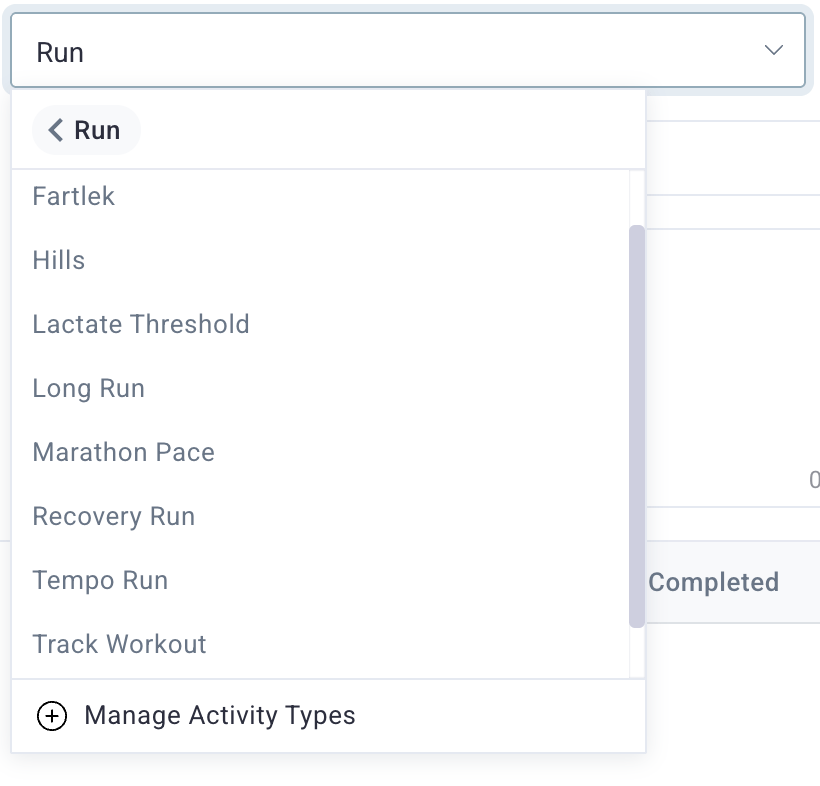
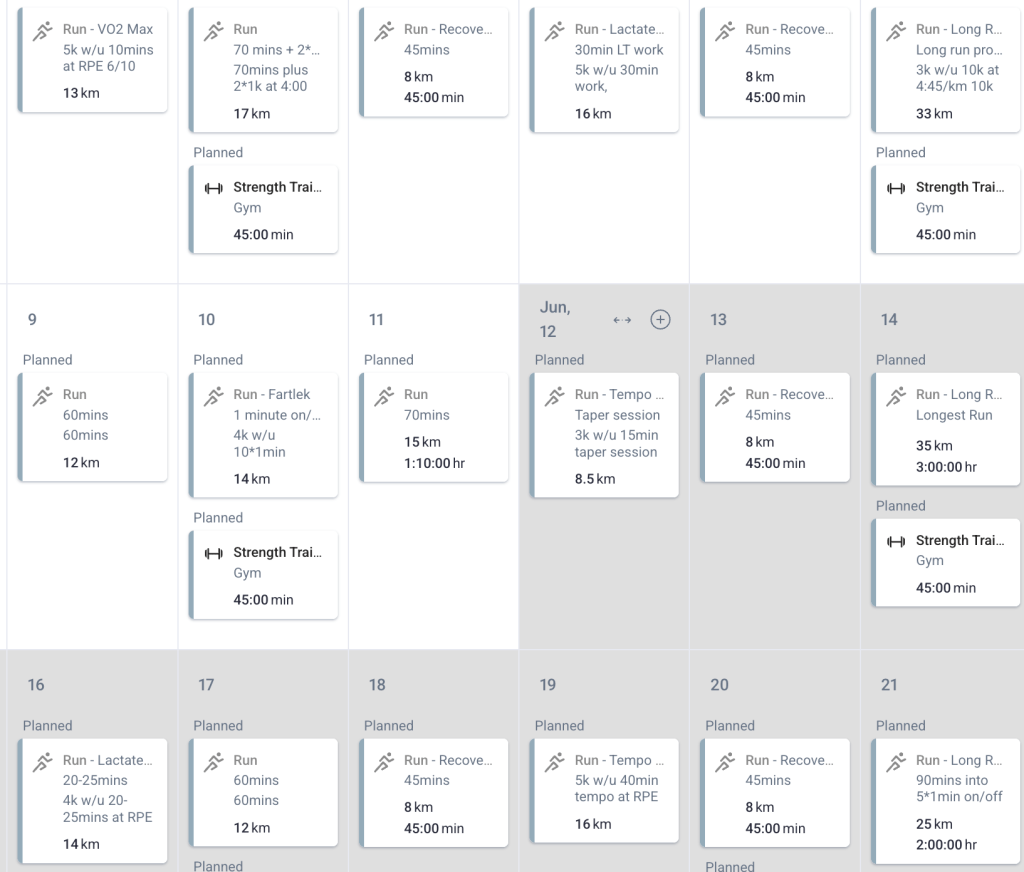
The Run Categories: On FinalSurge, when I program a run I can give it a different category and sometimes it can fit a couple. Other times it fits really just one and sometimes it doesn’t fit any. The real magic is in the description of the run and where it sits in relation to the other runs of your week. Here’s a breakdown of how I use the different ‘run’ categories:
- Fartlek: Used for any session where the aim is to run a little bit faster and then a little bit slower, generally using time as the metric to control that but not always. Examples are 2min/1min fartlek or 1min on/1min off. I use it in a few ways, either to put a bit of speed into your week (especially if the efforts are 1 minute or less), or a way to do 20-30minutes of continuous work that has some pace changes in it or as a way to keep a handbrake on you. If you have to slow down and speed up every couple of minutes it’s a great insurance policy for teaching patience I find.
- Hills: Sometimes I use this as a placeholder for ‘trails’ where I am suggesting to you to go out on the trails and get a different stimulus into your week. Trails are good because they force you to change your running gait regularly, test your muscles and heart a bit differently and exercising in nature is also a great stress reliever.
The other way I use Hills is in the form of a workout. It might be some fast, short stuff where most of us can push ourselves to a level of hurt we never experience on the flats just because of the extra work we have to do against gravity. I also may throw in hill strides as well to get some power out of your system. If you can do it on a hill, you can likely do it faster on the flats! - Lactate Threshold: Tricky one. Taking a step back first, scientifically speaking there are two thresholds but most runners will refer to the second one most often and forget the first exists. This ‘Lactate Threshold’ is the second one and is the one which is most often quoted as the magical pace your body could hold for one hour or the pace at which you can maintain lactate clearance at the same rate as lactate production.
Practically, I use it for serious controlled sessions where the aim is to run at or just below this magical lactate threshold pace/zone. I say magical because everyone’s is different and everyone will have variances in what their threshold pace is given the different variables in our lives. Using heart rate can be a great metric in this case but that means you need to have actually tested and found your threshold heart rate in a laboratory.
What does that all mean? Well, try to not get too caught up with your exact threshold pace but when I program a run using this category I’m using it for things like 3*8mins, 2min jog or similar. You should be settled into a good rhythm here and feel in control. If your heart rate doesn’t drop in the 2min jog the 8min effort was probably too hard and you’re way past the threshold already. Another way to think about it is it should be slightly slower than your 10k PB pace and slightly faster or around your half marathon PB pace. - Tempo: Threshold’s ugly cousin perhaps. Some people use threshold and tempo interchangeably as if they are one and the same which is not quite correct but then again, there’s marginally any difference between the two so it’s not a big issue. I like to use ‘Lactate threshold’ for serious controlled work and ‘Tempo’ for runs where it’s not so serious and you can take the foot off the gas pedal a bit. I might still program a tempo run as 3*8mins, 2min jog but if I do that, my intention is for you to just cruise it a bit more than you normally would. Don’t stress over the details so much. I might also just program a ‘steady’ run as a tempo run, or an out and back run as a tempo run. The paces aren’t that important to me, it’s just an idea of getting out there, running fast and maybe listening to music and just enjoying it all.
- VO2 Max: RPE 9/10 or RPE 10/10 type area. This is short, hard, fast running to test your ceiling. It’ll usually be 15-20mins maximum of intervals with sometimes being less after a really good warm up. It’s also a category that I might combine with hills at times too. Whenever you see a VO2 max workout on your program it’s a good idea to mentally prepare well or else it may just be a fartlek/threshold/tempo effort instead (which is OK if you need to adapt it to given your week!).
- Track Workout: Not many people will see this one mainly because Australia doesn’t have many tracks and besides the 14 Europeans I coach who regularly race 1500m on the European circuit, any complicated track sessions of 2*1000m, 6*400m alternating in 70s/72s finished with 400m, 300m, 200m in 31s, will just be a bit overkill. OK, I don’t actually coach 14 Europeans by the way. At best, there is an American living in London who reads what’s written here by an Australian.
- Recovery Run: Chill out when you see this run. It’s an easy run where the idea is that you need to feel refreshed and better for having done the run. If you’re all sore and stiff and then by the end of it nice and loose and happy, that’s a perfect recovery run execution. If you run a recovery run too fast and are even more sore and stiff by the end of it, that’s bad.
- Marathon Pace: Sometimes this one pops up in a session. If so, I am trying to target the pace you hope to start out at in your marathon. Take a bit more care with your pacing as a result and also your preparation so you can execute it well. This is especially so if I deem a long run to be Marathon Pace. Those are like dress rehearsals so put on your best outfit and break a leg out there (I hope you get what I mean and do not actually break a leg).
- Long Run: Pretty self explanatory. The idea with the long run is to lay the foundation for your long-term aerobic development. Keep these relatively controlled for the most part, and sometimes I might put a prescribed pace in there as well to stick to. Really depends on what you have coming up.
- No category: The type of running that doesn’t fit into any of these categories is your regular run of the mill easy running. Some days easy running pace might be 6:00/km, other days you might get rolling at 5:30/km. The important thing on these days is to ensure you don’t jeopardise whatever session you have coming up by pushing the easy run too hard. That could be from a pace/intensity point of view or else from a mechanical point of view by smashing too many downhills on trails. Obviously, if I’m really stipulating you take it slow on an easy run then I’ll list it as a Recovery Run. Without that listing though your destiny is partly in your hands.
There you go. You might want to look at your program and refer back to any of these and how they fit in. The lines between some of them are blurred a bit so don’t take them for gospel especially the Tempo/Lactate Threshold category.
Heart Rate Analysis: Behind the scenes, when I am checking on people’s runs to see how they went one of the areas I check the most is the heart rate data. This is especially true if it is a Lactate Threshold run or some other quality session. For easy runs, I’m not too fussed, especially so if I’ve given you the licence to run it at whatever pace/intensity.
When I look at heart rate data I am looking to see:
- how high it is in the session compared to the warm-up
- whether there was too much drift over the course of the run or session
- what it did in the recovery portion of a workout each time
- what it is for the pace given the weather and previous workouts
- if you manage to continue to push it high late in a hard session or race
- where it sat relative to what is normal for you
- and a few other minor things.
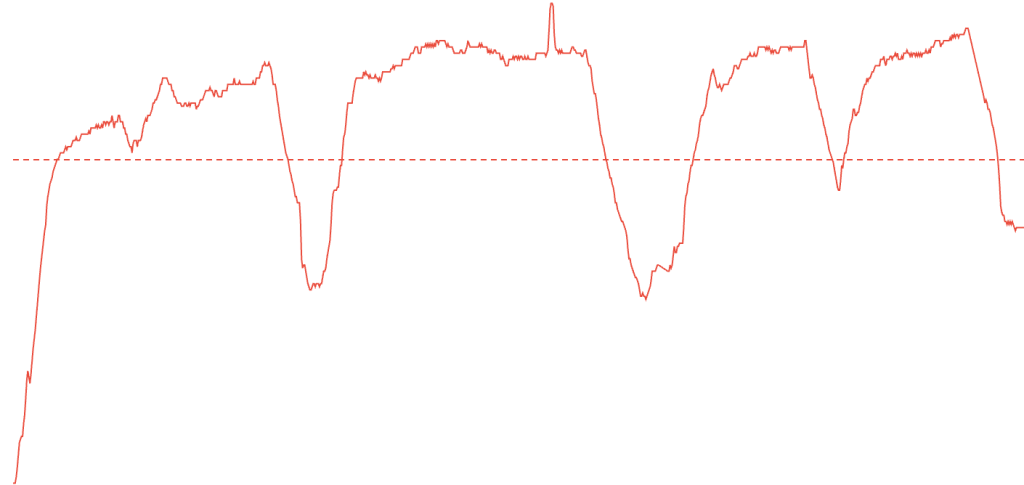
It’s not the be-all-and-end-all but it is a helpful clue to show how hard you were pushing in a workout or whether you are being hampered by too much fatigue etc. In a perfect world for an example athlete I’d notice one week they were able to run 5:00/km at a heart rate of 162bpm and then a month later they were holding 4:50/km at the same heart rate of 162 bpm. Clearly that athlete is now fitter and so the next step would be in ensuring they get the most out of their improved fitness on race day or just in their general running.
Total Km’s: If on a day to day scale heart rate is one of the most important things I look at then on a week to week scale it would be total kilometres run. It’s a simple indicator of total running load and any major spikes up or down usually represent an injury has occurred or may be about to occur. It also shows great progression as if an athlete was once on 30km’s a week and then progressed to enjoying 50km’s a week that’s fantastic! That’s an extra 20km’s per week someone is getting to go out and run.

Practically then, if you’re looking at your week and wondering whether it’s ok to shuffle things around or add in a last minute run, I’ll often check what your weekly km’s total is at and where it would go to with the change. There’s no real hard and fast rule to live by with appropriate increases in weekly km’s so it’s usually a matter of intuition from the athlete and experience from the coach coming together to find a solution or answer they’d both believe in in the case there was an injury. If you’re not prepared to suffer the consequences from any risks you take in training, then you’re not ready to receive the rewards from those risks.
One very important caveat with all this respect to total kilometres. Once a measure becomes a target it ceases to be a good measure. That’s Goodhart’s Law and it originally related to economics but I think you can appreciate it relates to mostly everything. It relates to total kilometres as if you neglect all signs of injury, fatigue or tapering for a race just so you can hit your magical 80km’s a week goal then that magical number will fail to actually represent what you want it to. This is a very easy trap to fall into and I put my hand up for making this mistake personally and professionally when coaching more than once.
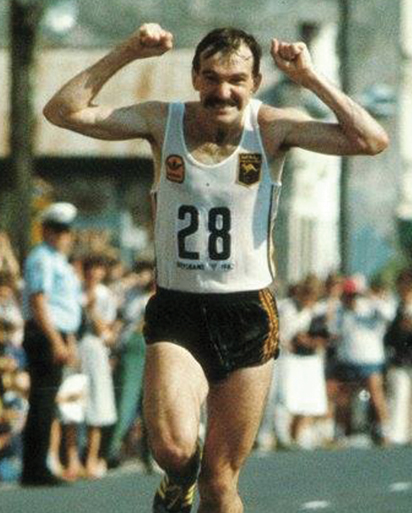
Personally, I get caught up in the neat representation of total kilometres on Strava as I shared in the image above. It looks so uniform and perfect, I must be doing everything right. Well yes, but you may also not be allowing room for recovery or supercompensation or big stimulus changes. Back in the time before Strava, when Rob de Castella roamed the earth, I’m sure he would’ve taken breaks when needed without worrying what would happen to his weekly mileage. If two or three rest days is important to heal a sore niggle or get over a cold then that’s more important than maintaining a somewhat unneccesary streak. I say unnecessary because when people sign up for coaching or enter races there isn’t usually anyone quoting ‘I want to run 40km a week for the next 15 weeks, rain hail or shine’ or similarly ‘Well I ran 55km’s for every week of my last six months so therefore in this race today I am owed at least a 1:45 half marathon, it’s just maths’. The mountains don’t care about mountaineers when they climb them and races don’t care about your weekly kilometres when you run them.
Any Other Business: Gold Coast Marathon is coming up in less than a month’s time. If you are running, good luck for your final training block. If you are not running, maybe put a reminder in your calendar to think about doing it next year or at least chatting to someone (me) about doing it next year and whether that’s a good idea.


Good luck as well to anyone going into winter running mode. That’s pretty much everyone except for our American friend in London and maybe anyone based in Port Hedland. I don’t think they get winter up there?
Thanks,
Fraser


Leave a Reply